Most roadway lighting complaints we hear are not about brightness. They are about dark patches between poles, glare into first-floor windows, or a fitting that failed in its second monsoon. All three trace back to decisions made before the fixture was ever chosen.
Here is the order we recommend working in: road width, then pole height, then spacing, then wattage. Wattage last. Choosing the wattage first is how sites end up over-lit at the pole and dark in between.
Step one: measure the road, not the budget
The single most useful number is road width from kerb to kerb. That decides pole height, and pole height decides almost everything else. As a rough working rule, pole height should be close to the width of the carriageway you need to light.
- Internal colony road, 5–6 m wide — 6 m poles
- Village or panchayat road, 7–8 m wide — 7 to 8 m poles
- Two-lane state road, 9–10 m wide — 9 m poles
- Four-lane carriageway, 14 m+ — 10 to 12 m poles, often twin-arm
Step two: wattage by road type
These are the wattages we supply most often against each road class. They assume a single-side pole arrangement and an efficacy of roughly 120–130 lm/W.
- Colony and internal roads — 24W to 36W
- Gram panchayat and village roads — 36W to 50W
- Two-lane state roads — 72W to 100W
- Four-lane and approach roads — 120W to 200W
- Toll plazas, junctions and open squares — high mast, 150W to 400W per head
Step three: spacing is where installations fail
The useful figure here is the spacing-to-height ratio — pole spacing divided by mounting height. Push it too far and you get the scalloped dark patches that make a road feel unlit even though every fixture is working.
- Ratio of 3.0 to 3.5 — comfortable uniformity, the safe default
- Ratio of 4.0 — acceptable on lower-traffic roads with wide optics
- Ratio above 4.5 — visible dark patches between poles, regardless of wattage
A 9 m pole at a 3.5 ratio means roughly 31 m spacing. If your existing poles are already at 40 m, no amount of extra wattage will fix the uniformity — you are better off with a wider asymmetric optic and accepting lower peak lux.
Step four: optics matter more than raw lumens
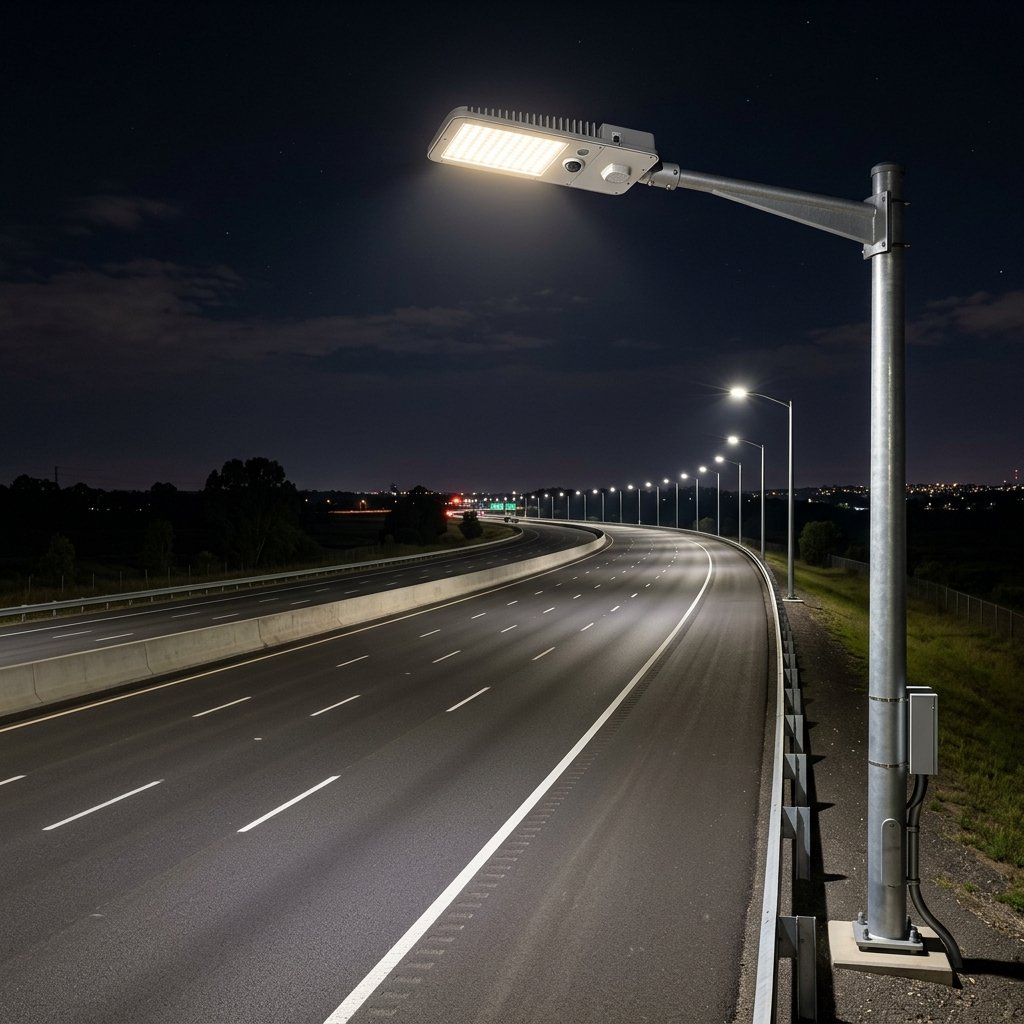
A symmetric fixture throws as much light backwards over the footpath and into windows as it does onto the carriageway. An asymmetric optic pushes the distribution forward along the road, which is why the same wattage can cover noticeably more road.
- Asymmetric Type II — two-lane roads, single-side poles
- Asymmetric Type III — wider carriageways and staggered pole layouts
- Wide symmetric — parking areas, yards and open ground, not roads
What to check before you order
- IP66 sealing on both the optic chamber and the driver bay
- Inbuilt surge protection — rural supply lines are the main cause of driver failure
- Pressure die-cast aluminium housing with a real fin array, not a flat back plate
- BIS certification and test certificates if the supply is against a tender
- A written warranty from the manufacturer, not a brand office
Send us the road width, pole height and existing pole spacing and we will come back with a wattage recommendation and a written quotation — usually within a working day.
11 products in this range, 18W – 200W, all IP66 with a 2-year warranty.