Box cricket turfs have multiplied across Gujarat in the last few years, and lighting is the part owners most often get wrong. The usual route is to buy the highest wattage the budget allows, mount it wherever a pole already exists, and discover that players cannot pick up the ball against the lights.
What lux level do you actually need
More is not better. Beyond a point you are paying for electricity that adds nothing to playability.
- Casual recreational play — 100 to 150 lux average
- Club level and paid bookings — 200 to 300 lux average
- Competitive matches — 300 to 500 lux average
- Broadcast or recorded play — 500 lux and above, with flicker-free drivers
For a typical commercial box cricket turf taking paid bookings, 200 to 250 lux is the sensible target. Uniformity matters more than the peak number — a ground averaging 200 lux evenly plays better than one averaging 300 lux with bright and dark halves.
Glare is the real problem
A batsman looking up at a rising ball is looking straight into whatever is behind it. If that is a bare LED array, the ball disappears. This is why lens optics matter on a turf far more than on a warehouse.
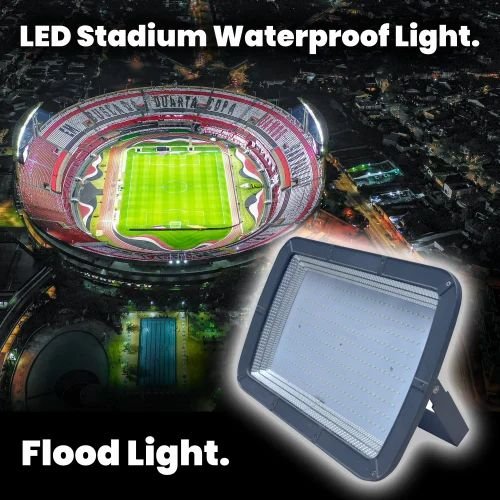
- Use lens-optic floods that control the beam per LED rather than one wide reflector
- Aim fixtures so the main beam is directed down onto the playing surface, not across it
- Keep fixtures above the normal sight line — higher mounting reduces glare more reliably than any shield
- Avoid mounting floods directly behind the bowler's arm
Pole positions for a standard turf
For a typical enclosed box cricket turf of roughly 30 m by 15 m, four corner poles at 8 to 9 m usually work better than a row down each long side. Corner mounting keeps fixtures out of the batsman's direct view and gives crossing beams, which improves uniformity and softens shadows.
On longer turfs, add a mid-point pole on each long side rather than increasing corner wattage.
Fixture count and wattage
- 30 m x 15 m turf, recreational — 8 x 150W lens-optic floods
- 30 m x 15 m turf, club level — 8 to 12 x 200W lens-optic floods
- 40 m x 20 m turf — 12 to 16 x 200W, or 8 to 12 x 400W on higher poles
These are starting points. The final count depends on pole height, how enclosed the turf is, and whether netting absorbs light — dark green netting takes a surprising amount.
Before you order
- Measure the playing area and confirm existing pole positions and heights
- Insist on IP66 — turfs are washed down and fully exposed
- Specify surge protection; turf supply is often a temporary or shared connection
- Ask for lens optics by name, not just a beam angle on a datasheet
Send the turf dimensions and pole positions and we will return a fixture count, a layout suggestion and project pricing.
3 products in this range, 150W – 600W, all IP66 with a 2-year warranty.